"The Joy of His Presence"
Notes
Transcript
Last year, when I returned from that ten-day trip to New York City, I walked off the plane exhausted—jet-lagged, hungry, and ready to be back home where the ground is flat and the tea is sweet. But nothing could have prepared me for what happened when I actually got home.
Yvette picked me up and drove me home from the airport in San Antonio. She’d been able to come up to New York City for a few days during my trip, so she didn’t miss me as bad, but when I got to the house, there they were—my girls—standing together. And the second they saw me, everything changed. Lily’s eyes filled with tears. Bethany started smiling so big her cheeks practically folded.
The girls ran to me, grabbed me, held on with everything they had. Yvette snapped some pictures, and those photo now sit in my office—a moment frozen in time where joy broke in so powerfully it felt like the whole world narrowed down to that embrace.
That’s what the presence of someone you love can do. Joy doesn’t just improve the moment—joy redefines the moment.
And that’s the kind of joy we’re talking about in Luke 2.
Because the shepherds weren’t out in the fields having a sentimental Christmas-card evening. They were doing the ancient version of the night shift: tired, overlooked, ordinary people just trying to get through another long stretch of darkness.
They weren’t looking for God. They weren’t preparing for an encounter. They weren’t expecting joy to show up at all.
But heaven had other plans. God breaks into their darkness with the announcement of a Savior, and suddenly joy erupts in a field no one cared about, among people no one thought much of.
And church family, that’s where many of us find ourselves this morning.
Some walk in carrying exhaustion. Some walk in carrying wounds from previous seasons. Some walk in carrying anxieties they’ve told no one about. Some walk in carrying the holiday ache that settles in when someone who should be here… isn’t. Some walk in careful—hopeful, but hesitant.
We say, “Joy to the world,” but deep down many of us feel joy-starved.
Here’s the tension we have to face honestly:
If Christ brings joy, why does joy often feel out of reach? Why does joy feel fragile, distant, or inconsistent—even among God’s people?
And this is why the shepherds’ story matters. Because their story tells the truth about ours:
Joy doesn’t begin when life gets easier. Joy begins when Christ draws near.
That’s the joy of his presence—and that’s where the gospel takes us next.
Christ’s presence brings joy to the overlooked
Christ’s presence brings joy to the overlooked
Luke tells us that the angelic announcement—the greatest news in human history—did not arrive at a palace, a temple, or a gathering of elites. It arrived out in the fields… to shepherds.
And shepherds in the first century were not winning popularity contests. They were not admired. They weren’t invited to leadership meetings. They weren’t considered reliable witnesses. They were ordinary, overlooked laborers working the night shift in a forgotten field outside a small town no one cared about.
In other words, if you were planning a public-relations rollout for the Messiah, you would not start here.
But God did. Why? Because Christ’s presence brings joy first to the overlooked.
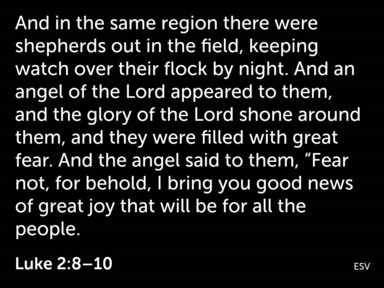
“Fear not,” the angel says, “for behold, I bring you good news of great joy that will be for all the people.”
Before the joy spreads to “all the people,” it starts with people no one expected.
The shepherds remind us that God is not drawn to the impressive. He is drawn to the humble, the available, the unseen. People who feel like they’re out on the margins—socially, spiritually, emotionally—are precisely the people God loves to surprise with joy.
Church family, this matters for us because we live in a place where many people feel overlooked in their own way.
There are hardworking folks in Midland who feel unseen—people doing shift work, hauling equipment, caring for aging parents, running small businesses, stocking shelves, keeping homes together. People just trying to survive the week. People who sometimes wonder, “Does anyone even notice what I carry? Does God?”
You may feel overlooked at work. You may feel overlooked in your family. You may feel overlooked in the church. You may feel overlooked by God.
But the shepherds’ story tells us: He sees you. He comes to you. He arrives for you.
And notice this—Luke doesn’t just say the angel appeared. He says the glory of the Lord shone around them. These overlooked men—accustomed to dark nights and quiet fields—were suddenly wrapped in the radiance of God’s presence.
God didn’t dim his glory for them. He didn’t lower the volume of his joy for them. He didn’t say, “This is too much for ordinary people.”
No—he floods their night with his glory. Why? Because Christ’s presence does not bypass the overlooked; it magnifies them. It dignifies them. It rejoices over them.
And this is good news for every person who has ever felt unnoticed, undervalued, or unseen: Christ delights to show up where you least expect him. He brings joy not only to the prepared or the polished, but to the weary, the wounded, and the ordinary.
The angels did not come to the temple first—they came to the field. And maybe this morning, that field is your heart.
When Christ draws near to the overlooked, joy breaks in where it never seemed possible. That’s the joy of his presence—and that’s where the gospel begins its work in us.
Christ’s presence brings joy that overwhelms fear
Christ’s presence brings joy that overwhelms fear
When the angel appears to the shepherds, the very first words out of his mouth are not an explanation, not a command, not even an invitation. The first words are: “Fear not.”
Before there is joy, before there is singing, before there is understanding… there is fear.
And that makes perfect sense. Shepherds were blue-collar men working the night shift, minding their own business, when suddenly the sky split open and the glory of God lit up the pasture. Anyone would be terrified. The text says they were “filled with great fear”—literally, fear mega-sized.
Fear is the shepherds’ starting point—and it is ours, too.
Some in our church walk into worship every week battling fear: fear of being hurt again, fear of being let down by leaders, fear of failure, fear of the future, fear of rejection, fear that their past disqualifies them, fear that their wounds are too deep for God to heal.
Some of us fear silence because silence forces us to face what’s going on in our souls. Some fear surrender because surrender feels like losing control. Some fear intimacy with God because it means releasing the image we have tried so hard to protect.
Fear is real. Fear is powerful. Fear shapes our reactions. Fear distorts our assumptions. Fear blinds us to what God is doing.
But here is the gospel truth embedded in this story: Christ’s arrival does not wait for fear to disappear—Christ’s arrival drives fear away.
The angel says, “Fear not… for behold, I bring you good news of great joy…” Joy is heaven’s antidote to fear. Not optimism. Not pep talks. Not shallow reassurance. Joy—deep, durable, anchored joy.
Why joy? Because fear thrives when we believe we are alone. When we think the burden is ours to carry. When we assume the future depends entirely on our ability to hold things together.
But the angel’s announcement dismantles all of that. “Unto you is born this day… a Savior.” In other words: You are not alone. You are not abandoned. You are not carrying your story by yourself. Someone stronger, someone wiser, someone faithful has arrived.
Fear shrinks when the presence of Christ expands.
Fear says, “You are on your own.” Christ’s presence says, “I am with you.”
Fear says, “You are not enough.” Christ’s presence says, “I (Jesus) am more than enough.”
Fear says, “This wound will never heal.” Christ’s presence says, “I came to bind up the brokenhearted.”
Fear says, “Your story ends in failure.” Christ’s presence says, “Your story is held by a Savior.”
This matters deeply for a church in a season of rebuilding trust. Fear—even quiet fear—keeps people guarded. Fear keeps relationships shallow. Fear resists vulnerability. Fear prevents mission.
But joy breaks fear’s grip.
And joy comes from the presence of Christ—a Savior who draws near, a King who reigns forever, a Lord who is with his people even in the night shift moments of life.
Here is the truth the shepherds learned, and the truth we must embrace: Where Christ is present, fear cannot rule. His joy is stronger. His joy is deeper. His joy overwhelms fear every time.
Christ’s presence brings joy because he is the Savior, Christ, and Lord
Christ’s presence brings joy because he is the Savior, Christ, and Lord
The angel’s announcement reaches its high point in Luke 2:11 “For unto you is born this day in the city of David a Savior, who is Christ the Lord.”
This may be the single most theologically loaded sentence ever spoken to human ears. Every word is intentional. Every title is explosive. Every phrase is meant to awaken joy in the hearts of people who had been waiting centuries for God to break the silence.
And each of the three titles—Savior, Christ, Lord—reveals the source of true, lasting joy.
Jesus is Savior.
Jesus is Savior.
The angel does not say, “A teacher has been born.” Not “a life coach.” Not “a moral example.” The first word heaven uses is Savior—one who rescues, delivers, and redeems.
Joy begins when we realize Jesus did not come to help us improve our lives but to save our lives.
In Midland, where self-reliance is almost a cultural virtue, this is hard news before it becomes good news. We like to fix things on our own—our jobs, our finances, our problems, our relationships. But we cannot fix our sin. We cannot fix our guilt. We cannot fix the distance between us and God.
Joy erupts when we accept what the shepherds learned: We don’t save ourselves — we are saved by the One who came for us.
Jesus is Christ.
Jesus is Christ.
“Christ” is not Jesus’ last name; it is his royal title. It means Messiah, the long-awaited King, the anointed One promised throughout the Old Testament.
This title tells us that Jesus is not a new idea. He is the fulfillment of every longing, every prophecy, every ache in the human heart. He is the one Israel waited for, the one creation groaned for, the one we were made for.
In a world full of temporary leaders, fragile systems, and roller-coaster circumstances, joy comes from knowing that the King we belong to is the Christ—God’s chosen, promised, unstoppable King whose kingdom cannot be shaken.
When we say “Jesus Christ,” we are not naming a memory; we are confessing a King.
Jesus is Lord.
Jesus is Lord.
This is the title of authority. Power. Sovereignty. Supremacy. It means Jesus rules—not someday, but now. It means all creation bows to him—even if they don’t recognize him yet.
For the shepherds, this was staggering news: The baby in the manger is the Lord of heaven and earth.
And this is where joy gets its backbone. Joy doesn’t come from circumstances going our way—it comes from knowing the Lord reigns even when circumstances don’t.
The Lord over uncertainty.
The Lord over wounds we’re still healing from.
The Lord over our families and futures.
The Lord over our church as we rebuild trust and deepen unity.
The Lord over every weary heart in the room.
This is why the angel called it good news of great joy. Because joy isn’t rooted in us—it’s rooted in him. In who he is. In what he has done. In the unshakable titles he carries forever.
He is Savior — so your sin can be forgiven.
He is Christ — so your hope has a foundation.
He is Lord — so your life has a Leader who will not fail you.
The shepherds' joy wasn’t found in a moment; it was found in a Messiah. Ours is too.
So, maybe you’re wondering how the presence of Christ brings joy here and now. I mean, the shepherds didn’t go looking for joy. They weren’t at a worship service. They weren’t fasting or praying or climbing a spiritual ladder. They were working the night shift—tired, unseen, uncelebrated. And yet that’s where joy found them.
Which means joy is not reserved for the spiritually impressive. It is offered to ordinary people… just like us.
So how do we welcome that joy? Here are three ways:
Bring your ordinary to Christ.
Bring your ordinary to Christ.
Some of us think joy requires a special moment or perfect conditions. But the shepherds remind us that Christ meets us in the plain, unfiltered, everyday realities of life.
Bring him your normal routines. Bring him your frustrations. Bring him your exhaustion. Bring him your questions.
You don’t have to dress up your life for Jesus. He brought joy to shepherds who smelled like sheep. He brings joy to Midland Christians who smell like work, stress, coffee, dust, and kids’ sports schedules.
Tell him the truth: “Lord, this is where I really am.” Joy begins in honest places, not polished ones.
Bring your fear into his presence.
Bring your fear into his presence.
The angels said, “Fear not,” because fear was the shepherds’ first response to glory. And it is often ours. The wounds many of you carry, the disappointments from previous seasons of church life, the anxiety about the future… none of that evaporates by pretending it isn’t there.
Joy doesn’t come by avoiding fear—it comes by letting Christ enter fear.
Whatever darkness you’ve been holding close—let him step into it. Say to him, “Jesus, I’m afraid here. Meet me here.”
Joy grows where Christ is welcomed, even tremblingly.
Bring your heart under his rule.
Bring your heart under his rule.
Joy is not just a feeling; joy is the fruit of surrender. The angels said the child was “Savior, Christ, and Lord.” If he is Lord, then joy flows where his authority is trusted, embraced, and obeyed.
Some of us want the comfort of the Savior and the hope of the Christ, but not the leadership of the Lord. But joy doesn’t flourish where we cling to control.
Where does Christ’s lordship need to be honored in your life? A relationship? A habit? A priority? A hidden pattern?
Joy comes where Jesus rules. Because Christ’s rule isn’t oppressive—it’s freeing. It is the rule that heals wounds, restores trust, and puts our lives back into the hands of the One who loves us most.
Christ’s presence brings joy to ordinary people in dark places. And that means joy is not beyond you—it is being offered to you.
Let’s hear the angel’s announcement as if it were being spoken over Midland in 2025:
Luke 2:10–11 “Fear not, for behold, I bring you good news of great joy that will be for all the people. For unto you is born this day in the city of David a Savior, who is Christ the Lord.”
Joy has a name.
It is not a circumstance.
It is not a season.
It is not an emotion.
Joy has a name, and his name is Jesus.
And the same Christ who entered a dark field outside Bethlehem is the Christ who enters the dark places of your life today.
He still comes to the overlooked.
He still comes to the fearful.
He still comes to the wounded.
He still comes to the tired.
He still comes to the unsure.
He still comes to churches rebuilding trust and rediscovering mission.
Church family, joy is not a luxury for religious professionals—it is the fruit of Christ’s nearness. And he is near.
And the joy that broke into the world at his first coming is a foretaste of the joy that will flood creation when he comes again. The presence that brought joy to shepherds will bring everlasting joy when the sky splits and the King returns.
So lift your heads. Joy is not something you chase. Joy is someone who has come to you.
If joy is found in the presence of Jesus, then here’s how we practice welcoming that joy:
Choose one place of darkness and invite Christ’s presence into it.
Choose one place of darkness and invite Christ’s presence into it.
Name it. Pray into it. Surrender it. Say: “Jesus, shine your light here.” He delights to enter dark places.
Choose one relationship where you will bring joy instead of withdrawal, bitterness, or silence.
Choose one relationship where you will bring joy instead of withdrawal, bitterness, or silence.
You cannot control how others respond, but you can control whether you carry joy or wounds into that relationship. This is especially important as Christ brings healing to our congregation. Joy is missional—it moves toward others in love.
Choose one person to share good news with this week.
Choose one person to share good news with this week.
The shepherds had one immediate instinct after meeting Christ: Go tell someone. And joy still works that way. Invite someone. Encourage someone. Pray with someone. Christ’s presence moves us outward.
Because joy shared becomes joy multiplied.
Christ’s presence brings joy to ordinary people in dark places.
Christ’s presence brings joy to ordinary people in dark places.
So let’s welcome his presence—this week, in this season, right here in Midland.
